
Concrete is one of the most durable construction materials in use which means that when it needs to come out, removing it requires purpose-built equipment and skilled operators. Across Detroit and Southeast Michigan, Concrete Demolition And Removal Detroit is a service in constant demand. Driveways, patios, sidewalks, foundations, parking lots, industrial slabs, retaining walls, and concrete block structures all eventually reach the point where removal is necessary either because the concrete has deteriorated, because redevelopment requires a clean site, or because the existing concrete no longer meets the needs of the property. This guide explains how concrete demolition and removal works and what distinguishes quality work in this specialized field.
Why Concrete Needs to Be Removed
Michigan’s climate is one of the harshest environments for concrete in the country. The freeze-thaw cycle repeated transitions between subfreezing temperatures in winter and warm temperatures in spring and fall creates hydraulic pressure within concrete as water infiltrates pores and cracks, freezes, and expands. Over time, this process causes concrete to scale, crack, spall, and heave. Detroit driveways, sidewalks, and patios are routinely affected by these mechanisms, and concrete that has deteriorated to a point of significant cracking, upheaval, or structural failure typically warrants removal and replacement rather than surface patching.
Detroit’s glacial clay soils contribute to concrete deterioration through a related mechanism. Clay is highly expansive it swells when wet and contracts when dry, applying variable upward and downward pressure to concrete slabs over the course of each year. This movement causes slabs to crack, develop differential settlement between sections, and eventually become uneven and unsafe. Replacing concrete that has been compromised by underlying soil movement requires both concrete removal and attention to the subgrade conditions that caused the problem.
Redevelopment and renovation drive another significant category of concrete removal in Metro Detroit. Site clearance for new construction, building renovations that require new utility penetrations through existing slabs, parking lot upgrades, and industrial facility repurposing all generate concrete demolition and removal scope. In some cases, entire floors of industrial buildings potentially many inches thick and heavily reinforced must be removed to prepare for new operations.
Methods of Concrete Demolition
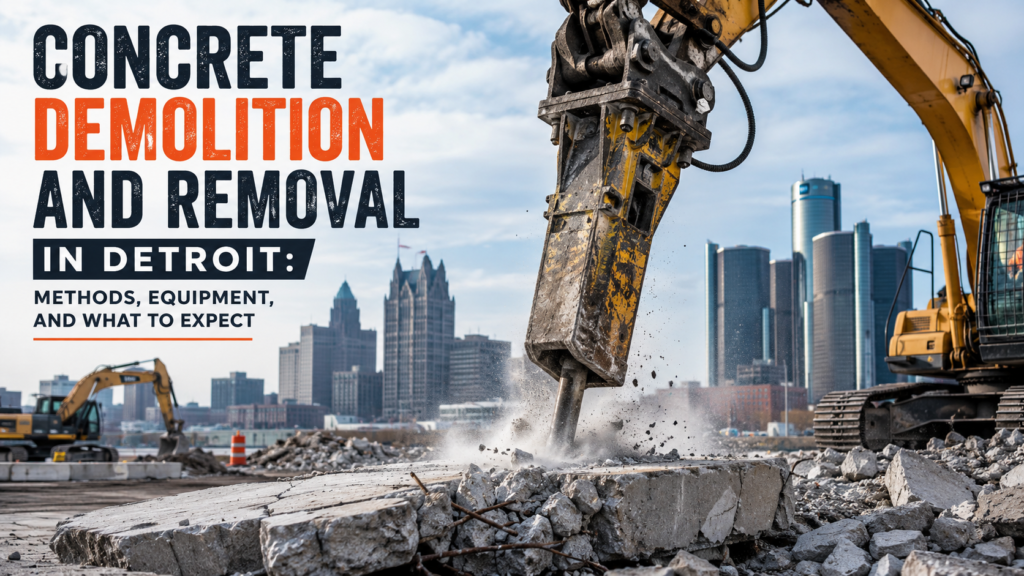
Hydraulic breaking is the most common concrete demolition method for most Detroit projects. An excavator equipped with a hydraulic breaker attachment essentially a powerful pneumatic hammer mounted on the excavator arm fractures concrete into pieces with repeated impact blows. Hydraulic breakers are available in a range of sizes to match the concrete thickness, reinforcement, and site access conditions. Smaller breakers mounted on mini-excavators work well for residential driveways and patios where site access is limited. Larger breakers on full-size excavators are used for industrial floors, parking structures, and foundations.
Concrete sawing is used when a clean, straight cut through concrete is required such as when removing a driveway section while leaving adjacent concrete intact, creating expansion joint lines, or making utility penetrations. Walk-behind concrete saws use diamond-tipped blades to cut through concrete to precise depths without disturbing adjacent material. Core drilling creates circular penetrations through concrete slabs and walls for utility installations.
Selective hand breaking with pneumatic hammers (jackhammers) is used in interior demolition settings where the confined work space and need to protect adjacent elements make large equipment impractical. Interior concrete floors, basement slabs, concrete topping slabs over wood framing, and concrete masonry unit (CMU) block walls are commonly removed by hand with pneumatic equipment in Detroit renovation projects.
Mechanical demolition with excavators without a hydraulic breaker, using just the bucket is sometimes used to break up lightly reinforced slabs where the excavator bucket’s direct downward force is sufficient to crack the concrete. This is faster than hydraulic breaking for thin, unreinforced slabs but not effective on thicker or heavily reinforced concrete.
Reinforcement and Its Impact on Removal
Modern concrete construction typically includes steel reinforcement rebar or welded wire mesh that significantly affects the concrete demolition process. Reinforced concrete breaks into large, connected pieces that must be manually separated as the reinforcing steel holds fragments together. Crews use bolt cutters, angle grinders with cutting discs, or plasma cutters to sever rebar as sections are broken apart.
The presence of reinforcement also affects the recycling pathway for demolished concrete. Concrete with rebar can be processed by concrete recycling facilities, but the rebar must be separated in the crushing and screening process. The steel reinforcement recovered from demolished concrete is recycled as scrap metal a positive environmental and economic outcome that offsets some removal costs.
Concrete Removal and Recycling in Michigan
Michigan has a well-developed recycling infrastructure for demolished concrete. Crushed concrete properly processed into recycled concrete aggregate (RCA) is accepted by a number of facilities in the Metro Detroit area and can be repurposed as base material for roadways, parking areas, driveways, and other applications where granular base is needed. This reduces the volume of material going to landfill and provides a cost-effective aggregate material for new construction.
For property owners and developers, concrete recycling is not just environmentally responsible it can also reduce project costs. Disposal fees for concrete at a landfill are higher than recycling tipping fees at a concrete recycling facility. Contractors who actively separate and recycle concrete pass some of these savings back to the project. Some projects even reuse crushed concrete on site as base material for new driveways, parking areas, or filled areas, eliminating both hauling and new material purchase costs.
Concrete Demolition in Detroit Industrial Contexts
Detroit’s industrial heritage has left a legacy of industrial concrete that presents some of the most challenging removal scenarios. Heavy industrial floors often 8 to 12 inches or more thick, with heavy rebar reinforcement designed to support manufacturing equipment require powerful equipment and patient, systematic breaking. Some industrial floors also contain embedded machinery anchors, pit structures, trenches, and other features that complicate removal.
Post-tensioned concrete used in some commercial and industrial construction, particularly parking structures requires special care during demolition because it contains high-tension steel cables under stress. Cutting a post-tensioned cable while it remains under stress can result in a violent release of energy. Contractors experienced in post-tensioned concrete demolition identify these structures before work begins and plan demolition sequences that safely manage this hazard.
Frequently Asked Questions About Concrete Demolition in Detroit
How thick of concrete can be removed? Professional concrete demolition equipment can break concrete of virtually any thickness, though thicker and more heavily reinforced concrete requires more powerful equipment and more time. Residential driveways and patios are typically 4 to 6 inches thick. Commercial and industrial slabs may be 6 to 12 inches or more. Foundations walls can be 8 to 12 inches thick or more.
How is concrete removed from tight spaces? Mini-excavators with hydraulic breaker attachments can access most residential backyards and interior spaces accessible through standard door openings. Pneumatic (air-powered) hand breakers handle spaces too tight even for mini-excavators. Experienced contractors assess access conditions before committing to specific equipment choices.
Will concrete demolition damage the surrounding area? Properly executed concrete demolition minimizes impact on surrounding areas, but some vibration and dust are inherent to the process. Water misting helps control dust. Operators use care near adjacent structures, utilities, and landscaping. If concrete is being removed selectively adjacent to areas that will remain, sawcutting along the removal line prevents cracking from propagating into the remaining material.